


Southwest Sciences has been at the forefront of research and applications in trace gas detection using tunable diode lasers throughout its 36-year history. We were among the first researchers to develop theory and implement into practice the use of frequency and wavelength modulation spectroscopy using diode lasers, introduced the use of Herriott cells for diode laser absorption measurements, and patented a newer design using dense pattern cells that permit even longer paths using commercial off-the-shelf, rather than expensive custom, mirrors.
Most recently, Southwest Sciences has emphasized the development of small, lightweight, low power, high speed, gas analyzing instruments suitable for portable or airborne applications. Custom electronics systems that are developed in-house allow for compact, low power instruments that perform all instrument control, data acquisition, processing, and reporting. These electronics, combined with newly available near-IR and mid-IR diode lasers and compact, lightweight optical designs, result in instruments that are hand-portable or can be flown on small aerial platforms such as weather balloons and quadcopter unmanned aerial vehicles. We are pushing this technology forward with the measurement of two or more gases in a single instrument and are developing instruments for space applications.
In addition to our work in trace gas sensing for atmospheric and environmental applications, other recent research areas include: high speed combustor diagnostics and measurement of electric and magnetic fields.
ATMOSPHERIC AND ENVIRONMENTAL SCIENCES
Atmospheric and Environmental Sciences
Researchers at Texas A&M University will be using a custom dual-gas analyzer developed by Southwest Sciences to measure N2O and CO2 dynamics in pecan groves and other agricultural settings. This instrument is configured for both land-based robotic buggy and unmanned aerial platforms. Contact: Alan Stanton.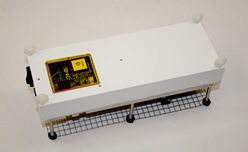
We have recently developed three compact gas analyzers for the EPA (hydrogen fluoride, carbon monoxide, and methane) designed to make airborne environmental measurements on their UAS quadcopter. These sensors are 21×8×8 cm in size, weigh 680 g and use 1.2 W of power. The system includes an SD card for data storage, GPS tracking and serial communications. Contact:Joel Silver.
Airborne Humidity Measurements
 Diode
laser-based detection of water vapor provides a combination of high sensitivity,
rapid time response, and wide dynamic range that is superior to most other
methods of humidity measurement. Southwest Sciences developed
a fast (50 Hz) and accurate (5%) hygrometer. Currently, our laser hygrometer is the mainstay water vapor instrument on the NSF Gulfstream V research jet being used by the National Center for Atmospheric Research. This hygrometer has been flying since 2008 and has more than 7,000 hours of flight time on more than 20 missions. It consists of an outside mounted aerodynamic pylon which contains an open path multipass cell. Independent measurements are reported at a 50 Hz frequency. For details, see the HIAPER
VCSEL Hygrometer page. Other past Southwest Sciences airborne humidity
projects include instruments deployed on a KC-135 and a Lockheed 1011 aircraft.
Contact: Mark
Paige or Joel
Silver.
Diode
laser-based detection of water vapor provides a combination of high sensitivity,
rapid time response, and wide dynamic range that is superior to most other
methods of humidity measurement. Southwest Sciences developed
a fast (50 Hz) and accurate (5%) hygrometer. Currently, our laser hygrometer is the mainstay water vapor instrument on the NSF Gulfstream V research jet being used by the National Center for Atmospheric Research. This hygrometer has been flying since 2008 and has more than 7,000 hours of flight time on more than 20 missions. It consists of an outside mounted aerodynamic pylon which contains an open path multipass cell. Independent measurements are reported at a 50 Hz frequency. For details, see the HIAPER
VCSEL Hygrometer page. Other past Southwest Sciences airborne humidity
projects include instruments deployed on a KC-135 and a Lockheed 1011 aircraft.
Contact: Mark
Paige or Joel
Silver.
Balloon-based trace gas sensors
Under DOE funding, Southwest Sciences developed a lightweight (1 kg), low power (2 W), and precise (0.3 ppmv) instrument to measure carbon dioxide designed for standard weather balloons. By using a proprietary temperature and pressure-compensating reference cell, the instrument can measure carbon dioxide from the surface to the lower stratosphere. The instrument uses low power and relatively inexpensive vertical cavity surface emitting lasers (VCSELs) combined with novel digital signal processors for data acquisition and analysis. A laboratory prototype water vapor sensor using similar technology can be operated off of a 30 cm x 30 cm solar cell. The water vapor hygrometer weighs just 230 g, including batteries, and measures water to part per million accuracy. Southwest Sciences is also investigating the feasibility of methane detection on balloon-based platforms under NSF funding. Contact: Joel Silver or Mark Paige
Measurement of Greenhouse Gas Fluxes
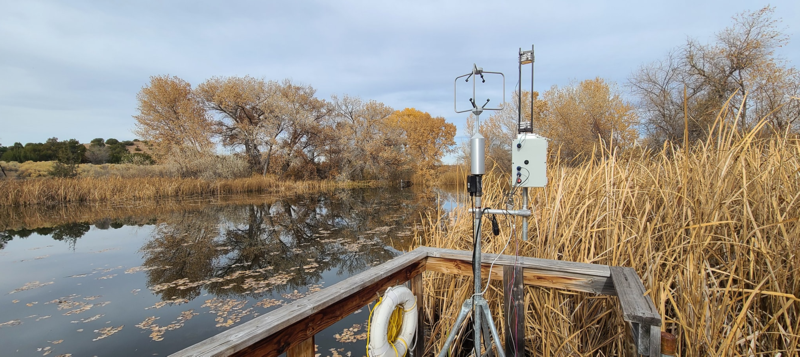
Nitrous oxide is the third most potent greenhouse trace gas and is largely emitted by agricultural practices. Wetlands are also important sources and sinks for N2O. There is an increasing need to both understand and track the sources of N2O and to use this information for mitigation strategies. The Department of Energy has been funding us to develop a high speed high precision N2O gas analyzer to measure fluxes of this important gas. The instrument operates in a region of strong nitrous oxide absorption near 4450 nm. The laser, detector, coupling optics, and electronics for instrument control, data acquisition, and analysis are all housed in a small enclosure directly attached to the open path measurement cell. The overall dimensions of the instrument are 29 × 11 × 4 inches, weighing 6.5 pounds. The power consumption is less than 5 Watts. The low power, amenable to battery or solar power operation, will permit widespread deployment of these instruments at remote sites, where access to electrical power is limited or not available. Contact: Alan Stanton.
HIGH SPEED COMBUSTOR DIAGNOSTICS
Measuring mass flow rate on a hypersonic rocket
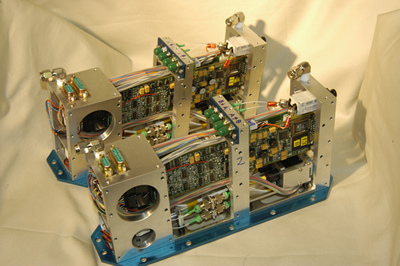 Optical mass capture instruments for measuring air intake during HIFIRE hypersonic engine experiments.
Precise knowledge of air mass capture is the most crucial parameter in trimming hypersonic aircraft engines for maximum thrust, fuel efficiency, and stability. The air mass capture can be determined by a direct measurement of oxygen concentration and velocity. Southwest Sciences has developed diode laser instrument for this measurement. Oxygen concentration is measured by absorption spectroscopy, while velocity is determined from the Doppler shift of the spectrum. The system fits in the payload of a vehicle developed for the Hypersonic International Flight Research Experimentation (HiFIRE) program. The vehicle is mounted within a sounding rocket payload and reaches an apogee of about 300 km. The peak Mach number during the flight is about 7.8.
The optical mass capture (OMC) system is designed to be functional during both the ascent and descent phase of the flight path, below 30 km for maximum oxygen density. Rocket launches will occur in Woomera, Australia. Contact: Joel Silver
Measuring Electric and Magnetic Fields
Atomic Magnetometry
Southwest Sciences is working with the research group of Professor Budker at Berkeley to develop nonlinear magneto-optical rotation with amplitude or frequency modulated light (AM- and FM-NMOR) and related methods for the practical measurement of magnetic fields. A modulated diode laser beam creates an atomic alignment in a gas of alkali atoms. The alignment rotates the polarization of probe laser, which is detected in a balanced polarimeter. The amount of polarization rotation shows a sharp resonance when the modulation frequency is a harmonic of the Larmor frequency. The sensitivity achieved in the lab can approach 1 fT (1e-15 T), whereas Earth's field is about 50 000 nT (5e-5 T) so very high precision is possible.
An exciting application of this technology is to measure the homogeneity of magnetic fields for various neutron electric dipole moment experiments. An electric dipole moment would violate fundamental symmetries and could explain the preponderance of matter over antimatter that is observed in the universe. In these "nEDM" experiments, neutrons precess in the presence of a modest magnetic field and a strong electric field. If neutrons have an electric dipole moment, their rate of precession will depend on the alignment of the magnetic and electric fields. This experiment requires a very stable and homogenous magnetic field. An array of AM-NMOR magnetometer heads constructed with optical fibers tracks the homogeneity of the field without perturbing it much. contact: Chris Hovde
Imaging Electric Fields
Together with the research group of Professor Douglas Beck, Southwest Sciences developed techniques for measuring spatially resolved electric fields using NV-doped diamonds. This has applications for physics experiments and for analysis of semiconductors. Contact: Chris Hovde
Contact Information
e-mail info@swsciences.com